Wednesday, 16 July 2008
Food prices soar while food supply dwindles in parts of Ethiopia, including the Oromia region, leaving food security uncertain.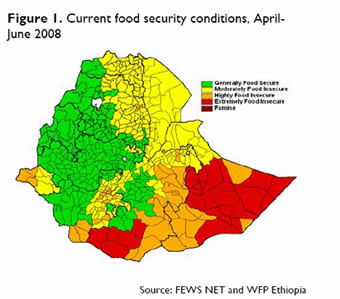
Critical and serious levels of acute malnutrition are reported in Borena zone of Oromia Region and Wolayita, Guraghe, Silti, Kembata Tembaro, Hadiya and Sidama zones of Southern Nations, Nationalities and People Region (SNNPR), following the poor performance of February to May [2008] rains and compounded by the failure of the short, local sapie rains (December [2007]/January [2008]). Malnutrition rates are also rising in the southern zones of Somali Region and the northeastern highlands.
The response capacity for the estimated 4.6 million people in need is threatened by extremely low emergency food reserve stocks and shortfalls in the food aid pipeline, including at the height of the hunger period (June to September [2008]). The food aid pipeline for cereals currently faces a 55 percent deficit for the July to November 2008 period.
Extremely high and soaring food prices are likely to further affect the food security situation of the urban and rural poor, as well as vulnerable pastoral and agropastoral populations, especially during the current hunger period. Retail prices for white maize, the cereal consumed most widely by the poor, are more than 150 percent higher compared to the same time last year in Addis Ababa, Mekele and Bahir Dar markets.
published by Reuters |